Sunday, 17 November 2013

Photographer - Tony Ray Jones at the Science Museum


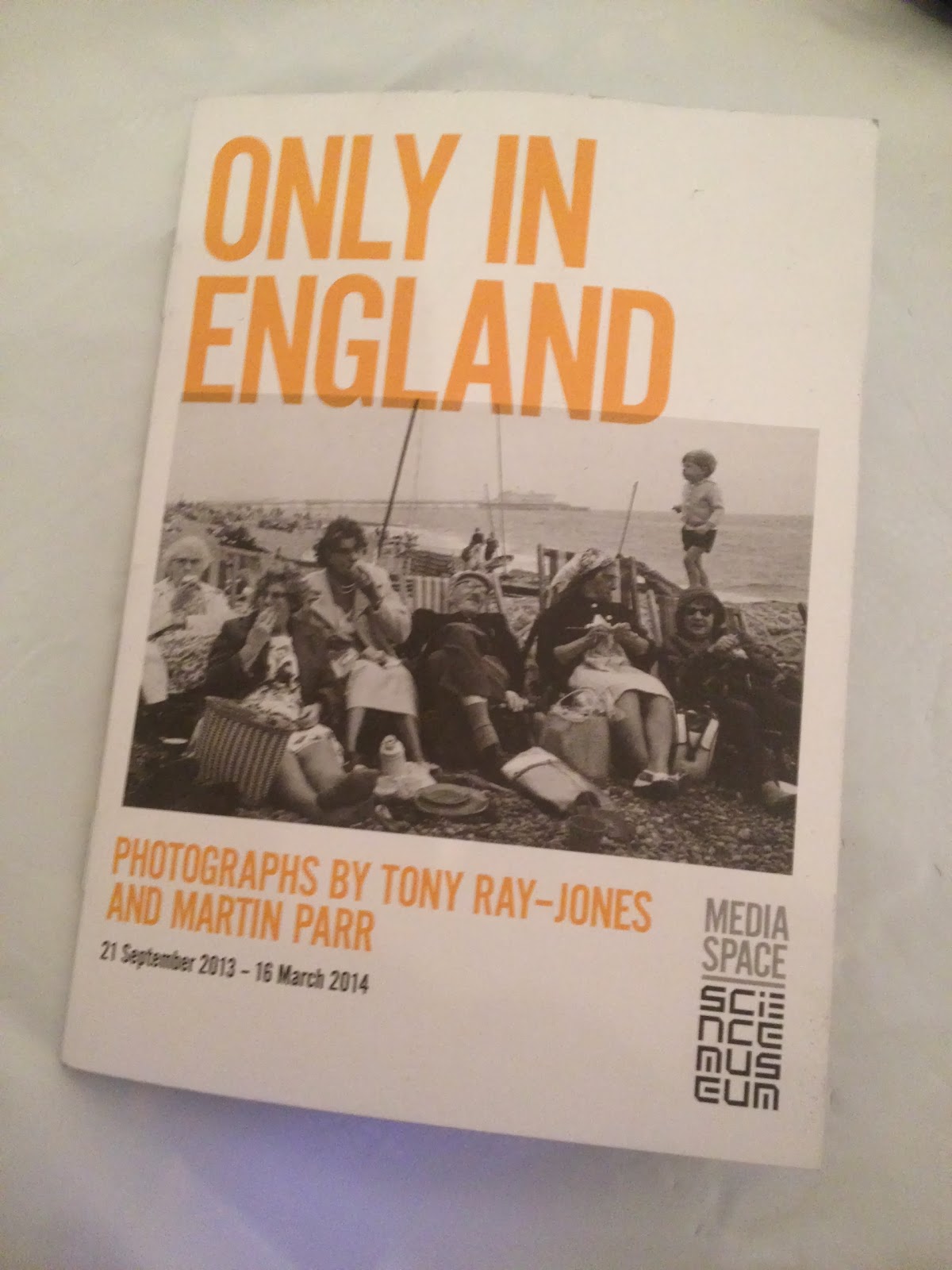
It was an entry in the wonderfully enigmatic and polemic quarterly Art magazine Jackdaw where I came across the work of Tony Ray Jones a British photographer who died all too young aged 31 back in 1972. His work is being shown at the ONLY IN ENGLAND exhibition at the Science Musuem's new Media Space.

He took the US documentary photography found in Walker Evans and more recently in the rediscovered Vivian Maier and gives it a very British look and feel. Where those US photographers used the streets and bars and to lesser extent their countryside Tony Ray Jones use the beach and the countryside to capture the British zeitgeist.

My two favourites from the exhibition which demonstrated British eccentricity and idiosyncracity at home on the beach and the countryside are:  Brighton Beach 1966 (I've been in similar seaside family pictures) and Glyndebourne, 1967 (a scene I 'm  sure you can see today!)
Glyndebourne, 1967

Brighton Beach, 1966
From a page on show from his  c1965 notebook  you can find tips and ideas which resonate today in our digital photography  age. I found stay with the subject matter (be patient) and get involved (talk to people) particularly relevant to me.


And yes, I did look for the Blacks and they were there both fictive aka in the blackened white faces style of the Black & White Minstrels, in the oddly named Bacup Coconut Dancers who seemed to be related to the equally odd Morris Dancer and yes both groups have there history 'lost in the mists of time' . There were of course some real blacks caught in the streets of Tony Ray Jones's London in 60's and 70's
Bacup Coconut Dancers, 1968

A good exhibition very intsrtuctive - recommended!

PS while doing the research for this post I came across the blog post of Blake Andrews in which he talks about rephotography, I have been meaning to do similar with a Jimi Hendrix picture....watch this blog


Monday, 23 September 2013

Another Bluebird ?

Belonging Walker Gallery Installation for Liverpool Biennial 2012. Image by © Mark McNulty 

Following on from my post about Katharina Fritsch’s Hahn/Cock  maybe this single colour bird thing is becoming a fashion ?

In an installation for last year's Liverpool's Biennal in an around its neo-classical Walker Art Gallery an artist uses multi-colour magnitude rather than the monochrome mass used by Fritsch in an attempt to create an aesthetic effect.

Belonging Walker Gallery Installation for Liverpool Biennial 2012.  Image by © Mark McNulty

Patrick Murphy’s Belonging is 150 ‘brightly coloured guests’ aka Ken Livingston's "rats with wings" aka pigeons painted various garish colours as appose to Katharina Fritsch’s Hahn/Cock single, 800kg bird. Murphy argues:
Belonging elevates the familiar site of pigeons [to] welcome, colourful visitors….. [evoking] questions about ownership and feelings of being accepted or marginalised. 
Belonging Walker Gallery Installation for Liverpool Biennial 2012 Image by © Mark McNulty 

I leave you to decide, for me Belonging is shop bought art, kitsch like Fritsch's.

Monday, 16 September 2013

A Cock-Up on the Fourth Plinth ?

Katharina Fritsch’s Hahn/Cock 
Aug '13 Photo © The Author
The pieces chosen for the fourth plinth in London's Trafalgar Square seem to be falling into the same pattern of much of contemporary  public art  today; they're Big, they're in a Unlikely place and they're Monochrome.

Look at Jaume Plensa’s Dream, visible from the M62 on the way into Liverpool; a white, 20m high structure of the thin, ashen face of a nine year old child; the planned Ebbsfleet Landmark Project By  Mark Wallinger at 40 to 50m impossibly, high white horse by the A2 visible to drivers to and from Ebbsfleet; Damien Hirst’s 20m Verity sinisterly, overlooking Ilfracombes’s harbour

The fourth plinth works seem to following this contemporary convention as most have been big pieces, in the unlikely setting of the plinth and with few exceptions, monochrome as seen in Elmgreen and Dragset , Powerless Structures, Fig. 101 or Marc Quinn’s Alison Lapper Pregnant and now Katharina Fritsch’s Hahn/Cock its plaque reads:
Hahn/Cock is a sculptre of a familiar domestic cockerel in ultramarine blue, made from fibre glass reinforced resin and fixed on a stainless-steel support structure.
The sculpture is 4.72 Meters high and weighs 800kg
Further that commonality of compositions perhaps has it source in the fact that three out of the six works artists’ share the same dealer – the White Cube – despite there being of thousands of dealers across the country with at least 500 in London.

Elmgreen and Dragset , Powerless Structures, Fig. 101 
Photo Aug '12 © The Author 


Marc Quinn’s Alison Lapper Pregnant
Photo Feb '07 © Fred Penfold
The artists invariably claim to bring ‘fun’ to art as well as addressing issues on the borders of some human emotion or physical dilemma. In Fritsch’s case  Hahn/Cock  “plays on the tension between reality and apparition, between the familiar and the surreal or uncanny” according to her publicists aka dealers - White Cube - on their web site.

For me, there is no aesthetic content in this cock at all, it is kitsch; on a par with mass produced blow moulded wellington boots ‘She captures and magnifies the uncanny’ her defenders say. Cock, uncanny ? Sigh!  Nonsense!

National Gallery, St Martin's, Hahn/Cock, Nelsons's Column
Photo Aug'13 © The Author and iPhone
This is art as spectacle, for tourists. This is ornamentation. Decoration. A backdrop to countless thousands of Trafalgar Square sightseers’ digital photographs, period.

There has been one work on the plinth that has worked for me, Yinka Shonibare's Nelson's Ship in A Bottle. Yes,  it's a cliché, a re-working of his trade-mark wax cloths nevertheless it works for me, proof that Fourth Plinth art can be more than a Big piece in an Unlikely place and Monochrome!

Yinka Shonibare, Nelson’s Ship in a Bottle
Photo Sometime after May '10  © The Author


Saturday, 17 August 2013

ArtEverywhere - Stanley Spencer's Neighbours

Stanley Spencer, Domestic Scenes: Neighbours 1936 , Oil on canvas 76 by 51 cm
I am a big fan of Stanley Spencer (1891-1959) the visionary, multi faceted  English artist , so much so I help out as a volunteer or custodian as we are called at his eponymous Gallery in Cookham, Berkshire, England.

Spencer’s popularity has increased in recent years reflected in the fact, his Neighbours 1936 was voted one of Britain’s favourite works of art  in the Art Everywhere project.

So the public and I had the chance to see Neighours on billboards all over the country.

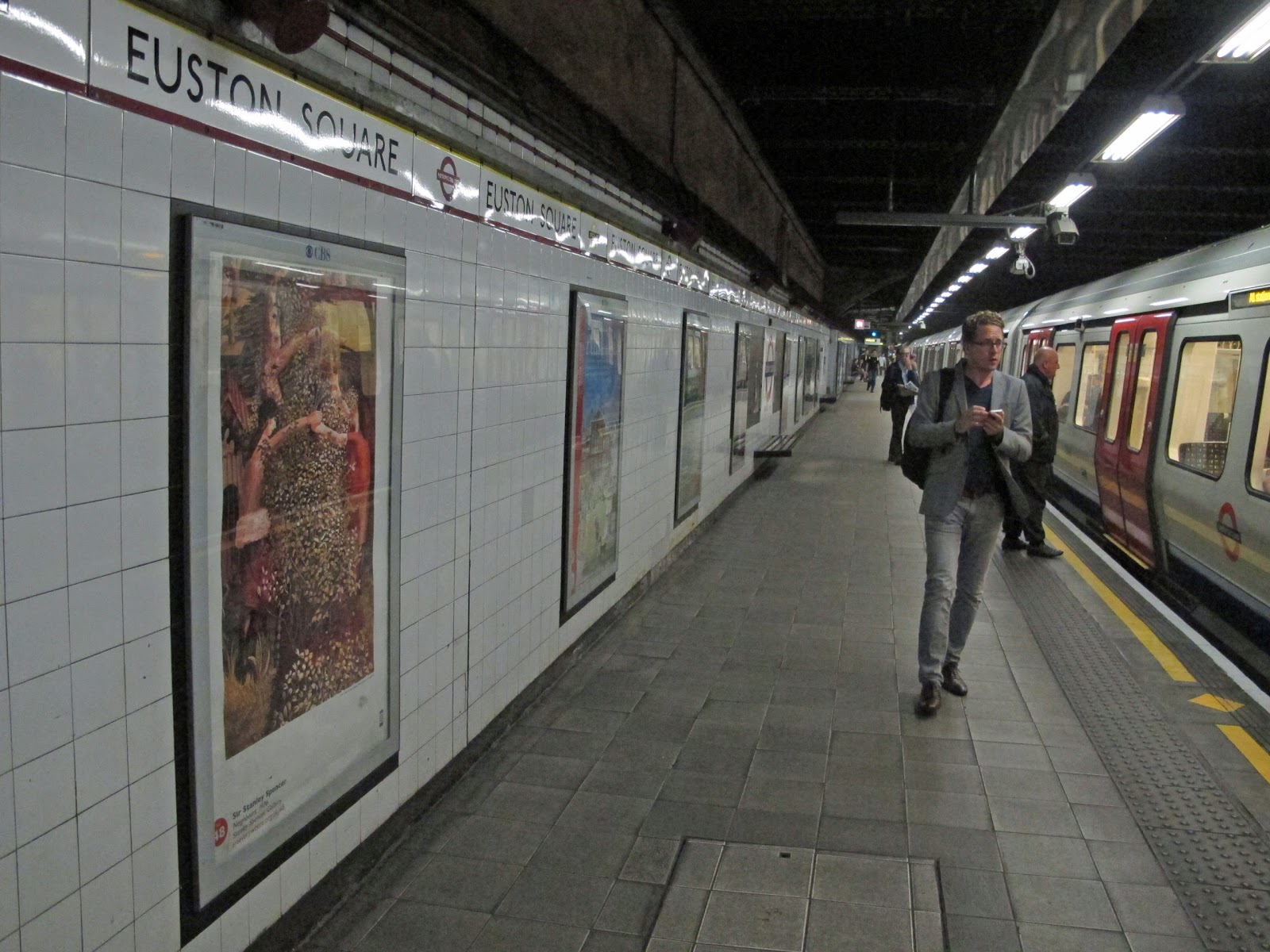
I was lucky enough to find Neighbours twice on a trip into London last night:


In the Tunnel connection Charring Cross Tube Station to its Railway Station


At the end of the platform of Euston Square Tube Station

ArtEverywhere is a brilliant idea - putting great works of art voted for by the public on billboards all over the country. The 50 works which made the short list  range from the abstract of Bridget Riley's Blaze 4 to the historical figurative of John William Waterhouse's The Lady of Shallot , demonstrating how popular Art is in general and Spencer in particular. 

Friday, 19 July 2013

Photographer - Walker Evans

Walker Evans Negro church, South Carolina, 1936

First came across Walker Evans preparing for a presentation at the Victoria and Albert and more recently researching for a forthcoming article on Appropriation Art. 

He has a very simple direct style his photographs are unromantic, factual - documentary - which I like very much as the photographs ask questions while maintaining an aura.

I have unwittingly (more of this when I discuss Appropriation Art) used this documentary style myself.....

Michael Ohajuru Storage Shed Somerset 2009


Monday, 8 July 2013

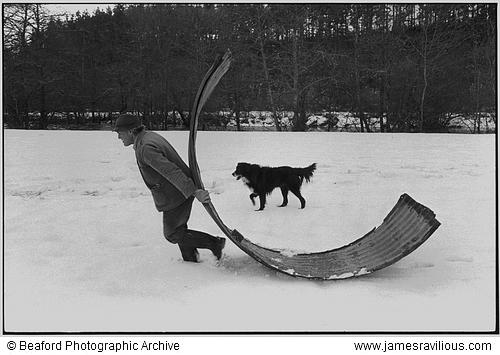
Photographer - James Ravillious


Writing about Vivian Maier and her work brought to mind another favourite photographer of mine - James Ravillious - he too worked in back and white. Where Maier captured  city life, Ravillious captured country life

Both extracted something enigmatic, endearing and enduring from the compositions they captured  from their sitters and scenes.

I find Ravillious's work equally as inspiring as Maier's 

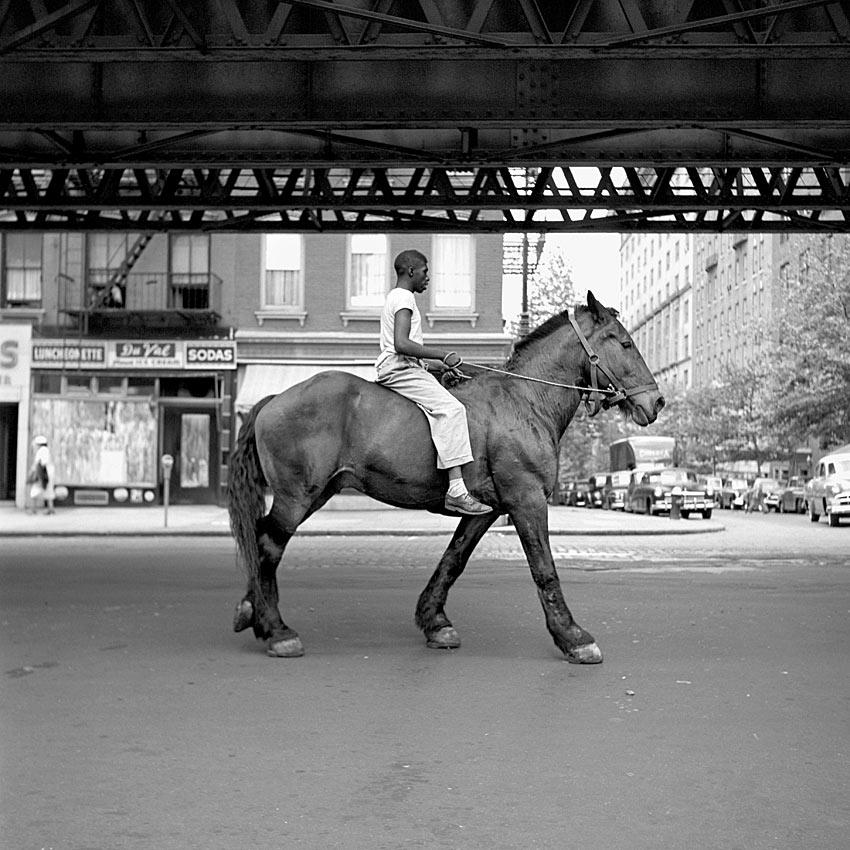
Photographer - Vivian Maier

August 11, 1954, New York, NY
Vivan Maier took over 150,000 pictures most of which were never developed or seen in her time. Only to be discovered as one of the great photographers of the 20th century after her death. And only after the self-storage space she rented sold the contents of her storage as it went unpaid after her death

What an extraordinary back story her life brings to her work. Nevertheless her art alone speaks itself, for her work really needs none of the art historical discourse cum rhetoric so nessesary to support so much of what tries to pass as art today. 

To me, her work is inspirational .